Events
Featured Projects & Events
Ongoing screenings, exhibitions, and performances across Africa, Europe, and the Americas. Institutional presentations engaging Africa’s entangled histories and epistemologies.
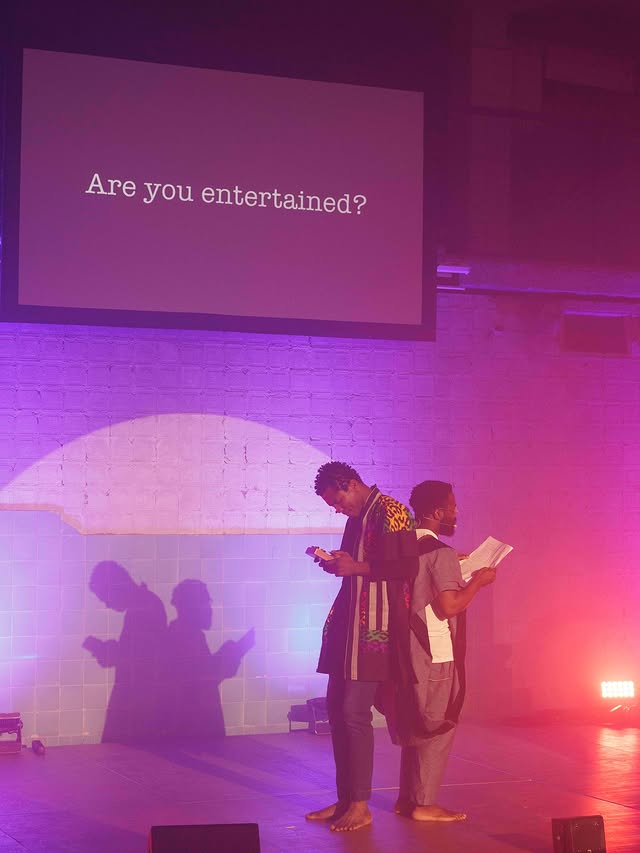
After the Wires our Hands Remain (Are you entertained?
After the wires, our hands remain, is a performance by David Odiase and hn. lyonga. It turns away from the cold gaze of algorithmic violence and the unseen labor behind western machines. Turning instead to the body, to breath, to bone, to skin, to memory. It explores the Anthropocene not as a timeline of loss, but as a call back to ourselves.
In this performance, we lean into memory not as something stored, but as something lived, felt, heard, touched, intuited as something that hums beneath the soles of our feet, or slips between breath and bone. Rooted in pan-african traditions, Afro-diasporic wisdom, and black feminist ways of knowing and being, this performance rejects the straight lines of colonial logics. It refuses their definitions of technology, of archive, of time. Instead, it moves in spirals. It listens for what the future remembers. It gathers the fragments, the whispers, the rhythms, the ghosts, and calls them technology. not in code, but in spirit. not in data, but in the pulse of our becoming.
Quantum Poetics
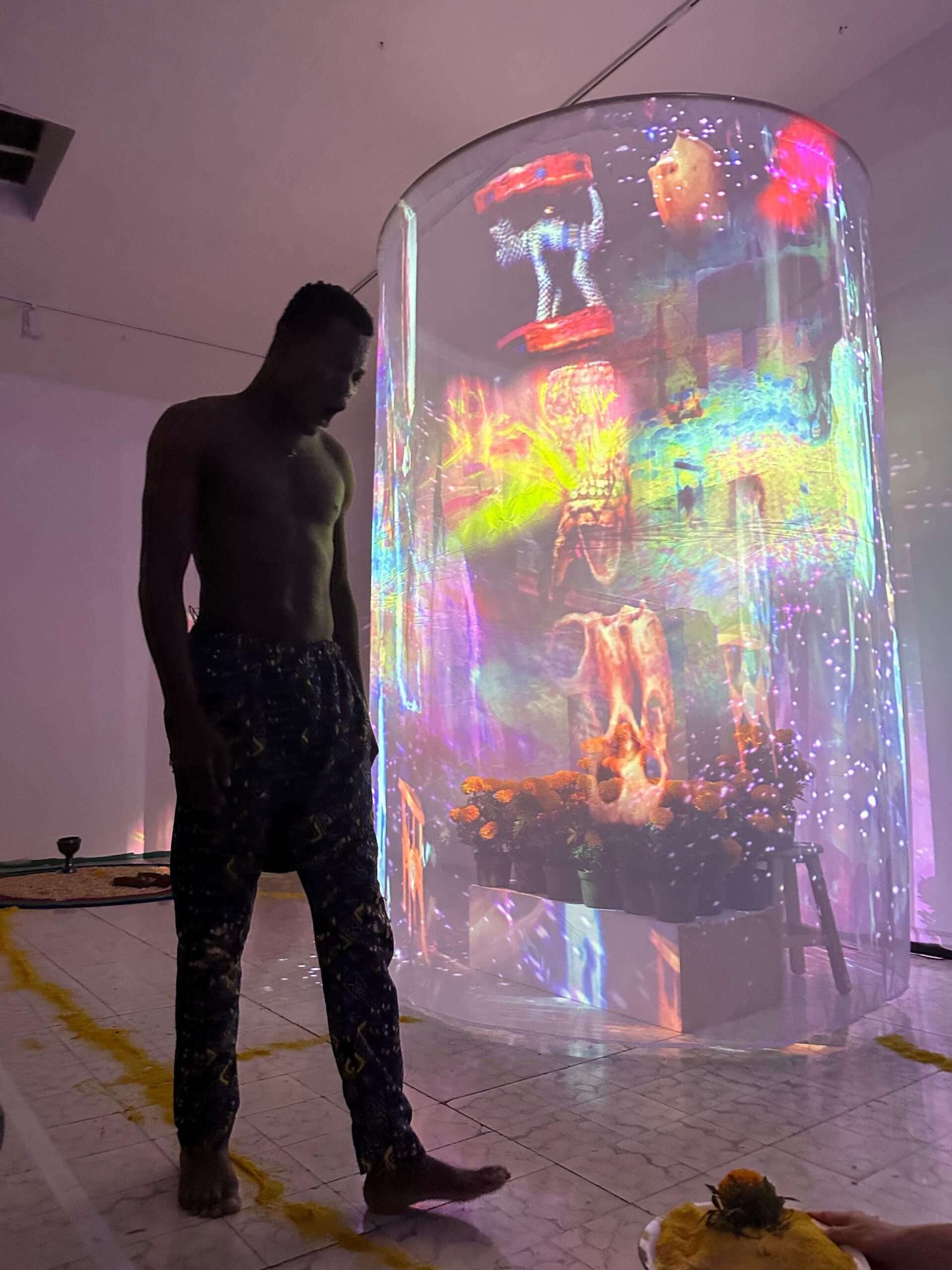
QUANTUM POETICS 2024 at Haus der Kulturen der Welt, Berlin, marks one hundred years since the first quantum experiments in Western science. Within this context, Fertile Void approaches quantum technologies as a dynamic field of scientific, artistic, cultural, and cosmological inquiry. Presented as part of Berlin Science Week, the programme unfolds over three days of keynotes, exploratory talks, panel discussions, and workshops with artists, scientists, experts, and cultural practitioners.
Today, poetics is recognizably part of the scientific endeavour. Quantum theorizing itself is a matter of storytelling, echoing Donna Haraway’s assertion that it matters which stories we tell in order to tell other stories with them. Inspired by the social and cultural significance of the griot, the West African figure who carries and transmits ancestral wisdom through oral tradition, this poetic offering entangles folklore, embodiment, positionality, and questions of translation and transmission of knowledge in a quantum age.
The spoken word and storytelling session brings together David Odiase and Chandrika Narayanan-Mohan in a shared performance, accompanied by generated images. Together, they enact a collective embodiment of the griot and other storytellers, archivists, and divinators whose practices traverse geographies and time.
CLOTH-READING (2025)
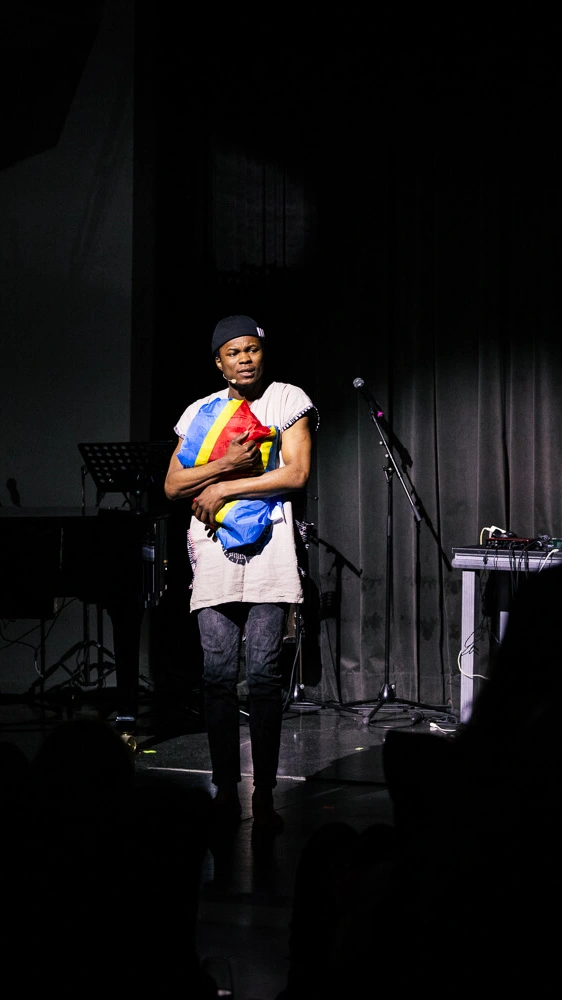
Is a performance poetry and clothesline installation presented at Haus für Poesie, Silent Green, Berlin. Drawing from a reflection by poet Marwan Makhoul, who writes that in order to compose poetry that is not political one must listen to the birds, and in order to hear the birds the war planes must be silent, the work situates itself in the shade of this epiphany.
Cloth-Reading becomes an act of accompaniment and witnessing. It visits the widow’s house, walks with search parties looking for missing children, and gathers soiled garments from the streets of Goma in the Democratic Republic of Congo, holding, reading, and washing them as a first gesture toward the making of a peace flag. The work draws on Indigenous knowledge of cloth cultures, dyeing practices, and linen washing, using these processes as a vocabulary for witnessing conflict through what clothes remember when bodies are no longer present.
The performance asks a central question: what does it mean to learn the dialect of clothes after the body has fled?
Spanning approximately twenty minutes, the work integrates song, soap, dye, dirty linens, poetry, movement, and water. These elements culminate in a final act of sun-drying on a clothesline, transforming acts of care into a collective ritual. A version of Cloth-Reading has previously been presented as part of Haus für Poesie’s Vocations programme in Berlin.
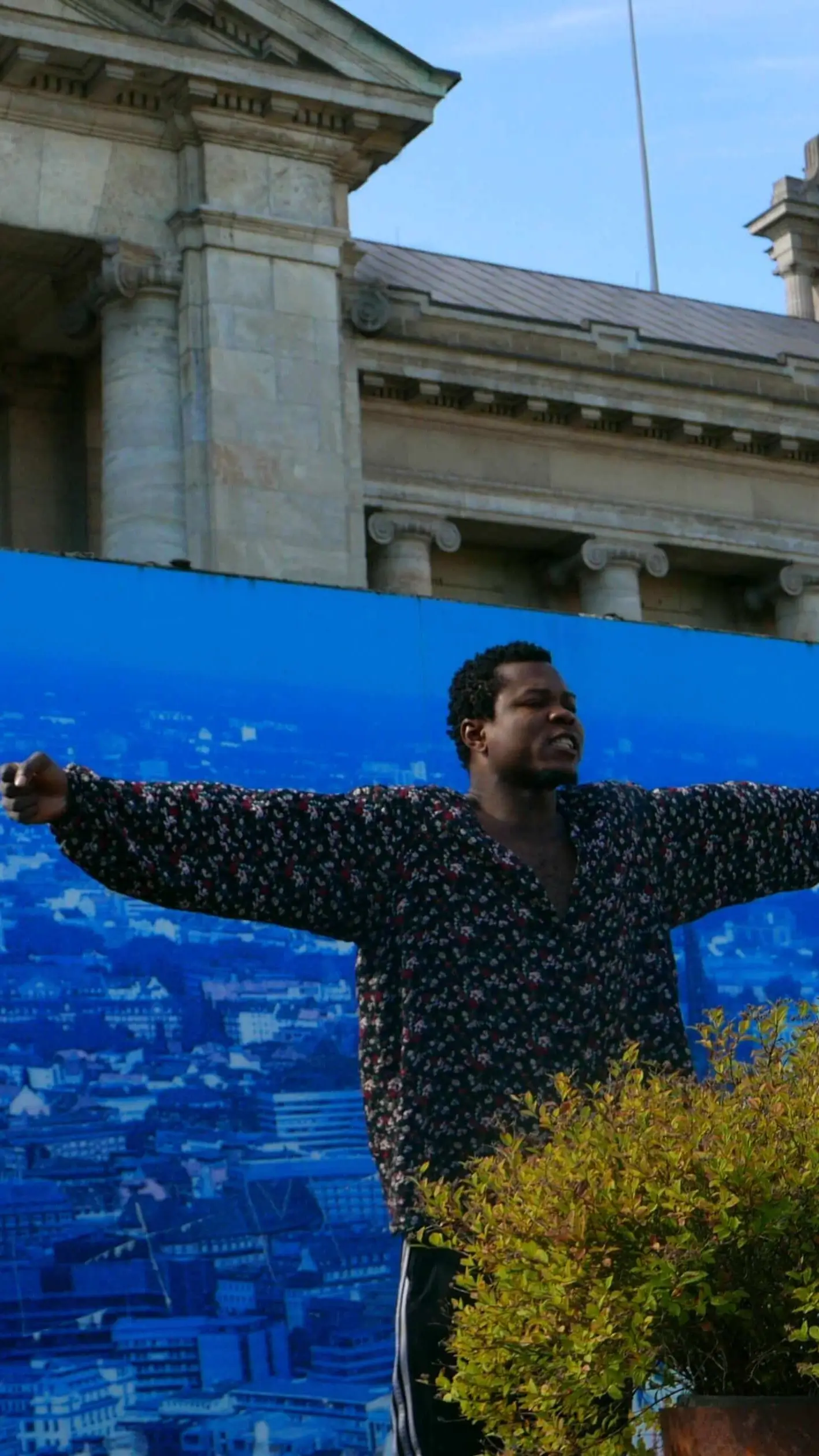
Photo credits: Miguel Ferraz Araujo & Dmitry Vilensky.
Here + Now + Everyone - Pictures
On August 17, I participated in Here + Now + Everyone / When Roots Move, a participatory performance at Gloria Friedmann’s 1997 monument Hier und Jetzt in Hamburg. The work, part of the Counter-Monuments series of Stadtkuratorin Hamburg and Sommerfestival Kampnagel, was developed by widely acclaimed Artist collective – Chto Delat International — Tsaplya Olga Egorova, Oxana Timofeeva, Nikolay Oleynikov, and Dmitry Vilensky — in collaboration with Vera Shchelkina, Masha Gyurova, Maria Markina, Bahar Ensafi, Sofiiia Greben and the Musikong Bumbong orchestra.
More than just a memorial for the victims of National Socialist justice, this gray concrete block marked “1933” stands alongside 90 iron steles that once held diverse plants — roses beside nettles, medicinal herbs beside poisonous ones – a living metaphor alluding to the coexistence of cultures, religions, and communities. Over time, this diversity was lost as the pots were replanted uniformly, and some emptied, erasing the monument’s original intention.
Gloria Friedmann’s intent behind the number of flowers pot (90) was to tally with the number of judges at the courthouse, and assign a pot to each of judges to care for and to water. By caring for their flower, they would be reminded to take care of people: the downtrodden, and oppressed who look to them for justice. Sadly this idea didn’t not work because it was considered ‘impractical’.
Our performance sought to reactivate this site and invite public introspection on the meaning of roots as a symbol of migration, diversity, but also in world rife with human rights suppression. What does it mean to exist on foreign soil and how can we hold spaces each other through collective care?
Cloth-Reading becomes an act of accompaniment and witnessing. It visits the widow’s house, walks with search parties looking for missing children, and gathers soiled garments from the streets of Goma in the Democratic Republic of Congo, holding, reading, and washing them as a first gesture toward the making of a peace flag. The work draws on Indigenous knowledge of cloth cultures, dyeing practices, and linen washing, using these processes as a vocabulary for witnessing conflict through what clothes remember when bodies are no longer present.
The performance asks a central question: what does it mean to learn the dialect of clothes after the body has fled?
Spanning approximately twenty minutes, the work integrates song, soap, dye, dirty linens, poetry, movement, and water. These elements culminate in a final act of sun-drying on a clothesline, transforming acts of care into a collective ritual. A version of Cloth-Reading has previously been presented as part of Haus für Poesie’s Vocations programme in Berlin.
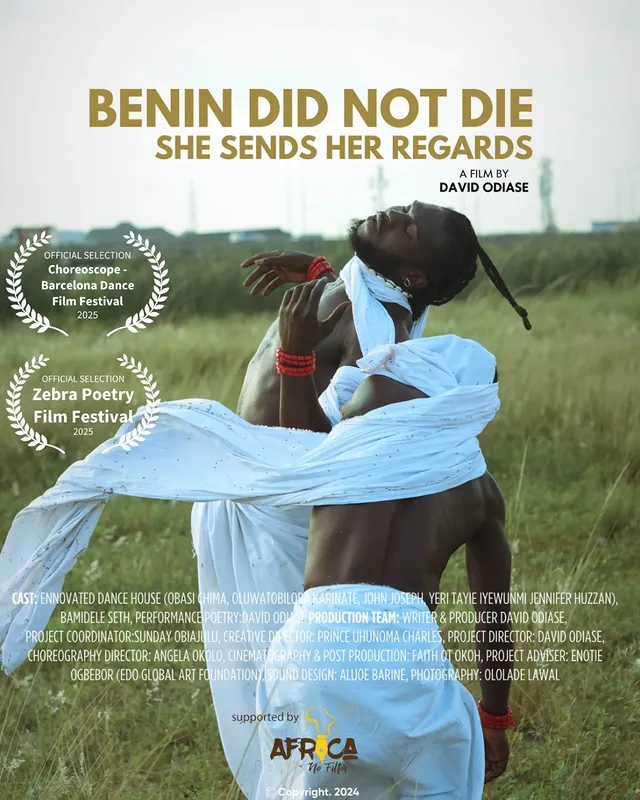
Benin did not die
She sends her regards, follows the journey of a curious throng of mourners, accompanied by a poet and a group of Performers, in a semi-urban African town on a journey to bury their dead. It won the Best International Short Dance Film Award at Choreoscope Barcelona Dance Film Festival 2025 and has been official film selection at notable film festivals in across the world.
We see a young man place a phone call to the British Museum, seeking to inquire from the souls of his ancestors when they will be coming home. it is a response to the conversations from stakeholders, held at the Global Convening for the Restitution of African Heritage, recently held in Accra Ghana, by Open Society Foundations As an African who hails from the Great Benin Kingdom, with many of our cultural artefacts (and in some cases human remains) stolen and taken to western museums such as British museum, this project is my way of advocating for reparations for victims of colonial injustice.
Open Line was a finalist at the 2023 Emmys’ International Young Creative Award and won the director’s choice at the 60 Seconds Short Film Fest, in Richmond Virginia, USA.
The Agony of Dying Trees
The Agony of Dying Trees is an experimental visual essay inspired by the prison poems of environmental activist Ken Saro-Wiwa. In Ogoni, Saro-Wiwa laments the violence of extractivism on his homeland, enabled by the unholy alliance of oil corporations and a government blinded by profit.
The essay draws from the memory of what is now known as the Ogoni Nine execution. Saro-Wiwa and eight other members of the Movement for the Survival of the Ogoni People (MOSOP) were sentenced to death after a shoddy and deeply contested trial that accused them of inciting murder. It also gives commentary on the hanging questions that lingers, even today.
RAIN IS NOT THE CLOUD'S LAST PARADE
is a film that employs multidisciplinary artforms such as poetry, sound and visual arts, performance, and fire breathing, as a portal for delving into the complexities of life in Nigeria. It reflects on the country’s tumultuous history, addressing themes like police brutality and tribal and political instability, showcasing our struggles, but not without reminding us that hope and resilience persist even amid challenges. The film earned special mention at the CANEX WKND 2024, which held in Algiers, Algeria.
Clairvoyance
Clairvoyance is a performance piece that personifies the concept of limits and inhibitions, as an extension of the spirit self, postulating mind and matter as one inseparable entity. It could also be considered as a metaphor for our subconscious search for sixth sense clarity.
TIGER CLAW
Is the first of 3 episodes, of a Poetry documentary series titled BIAFRA: NATION UNDERWATER ON FIRE. It is an educational content that employs documentary footage and spoken word poetry to tell the moving tale of the Nigerian civil war which lasted from 1967 – 1970. The aim of which is to promote Historical Cultural literacy.
Tiger Claw is the name given to the first military operation to recapture Biafran territories from the seceded Igbo government, the resultant of which lead to two and half years of the war, there were about 100,000 overall military casualties, while between 500,000 and 2 million Biafran civilians died of starvation.
Special tribute is paid here to the person and legacy of Christopher Okigbo, a widely acclaimed poet and soldier who died fighting in the war and till this day is regarded as one of Africa’s greatest poets.
Mandela’s Shoes
Seeks to interpret the theme of UTUKUFU by charting the Fundamental Human Rights Struggle of African Nations through the giant strides of those who have led them.
It leans into the SDGs goals’ attainment, advocating for Young Africans to take up the mantle in restoring our continent’s former glory by threading their own path in their various fields.
It also explores sub-themes such as: Cultural heritage, Unity among nations, Press Freedom, the strengthing of Conflict resolution efforts with Sudan as a case study, conversations around African arts restitution, ending with a clarion call to all Africans to rise to the occasion of being Champions for Continental Change.
OWBA COOCOO
Is a spoken word short film that chronicles African history and humanizes the experience of Black slaves as they crossed the Door of No Return to the wooden sea vessel, embarking on a horror-filled voyage to the New World. Even today, we still feel the bane of these events, a reality Owba Coocoo confronts in its narrative. Albeit there exists a plethora of works, both visual and textual, on the general slave experience, very few works by African storytellers focus on the slave ship itself. It was more than just a vessel of conveyance to the New World; it was a place where Black slaves from diverse backgrounds formed a general language for communication, shared stories and songs, and developed a nascent culture. Owba Coocoo seeks to bridge this narrative gap. the film ensures that the experiences of those who endured this journey are remembered and that their perseverance is celebrated..